Ask a child what they learned in a project-based STEM class, and they rarely describe a concept from a textbook. Instead, they will usually tell you about the robot they built, the circuit that finally worked after three attempts, or the app they coded from scratch. That difference — remembering what you built rather than what you read — is at the heart of why project-based STEM learning has become such an important part of modern education.
What Is Project-Based Learning?
Project-based learning is an approach where students learn concepts by applying them to build a real, working outcome, rather than studying the concept in isolation and being tested on it afterward. Instead of a chapter on circuits followed by a written test, project-based STEM learning asks a student to design, build and troubleshoot an actual circuit that performs a task. The concept is not separate from the outcome — it is discovered through the process of building it.
Why Building Real Projects Is More Effective Than Theory Alone
Theory tells a student what should happen. A real project shows them what actually happens — and forces them to figure out why, when it does not match expectations. This gap between theory and practice is where the deepest learning happens. A student who reads that a motor needs sufficient voltage to run understands a fact. A student whose robot fails to move because of exactly that issue, and who has to diagnose and fix it, understands a principle they will not easily forget. Project-based learning consistently produces this kind of durable understanding because the consequences of a concept are immediate and visible.
Learning Through Experimentation
Every real project involves a cycle of experimentation: trying an approach, observing the result, and adjusting based on what happened. This is not a side effect of project-based learning — it is the method itself. Children learn to treat their first attempt as a starting point rather than a final answer, and they become comfortable testing, measuring and refining, which mirrors exactly how engineers, scientists and developers work in the real world.
Types of Projects That Build Real-World Skills
Designing and Building Circuits
Circuit-building projects teach students to translate a plan into a physical system — connecting components correctly, testing continuity, and troubleshooting when something does not power on. These fundamentals underpin almost every other technology project a student will build later.
Robotics Projects
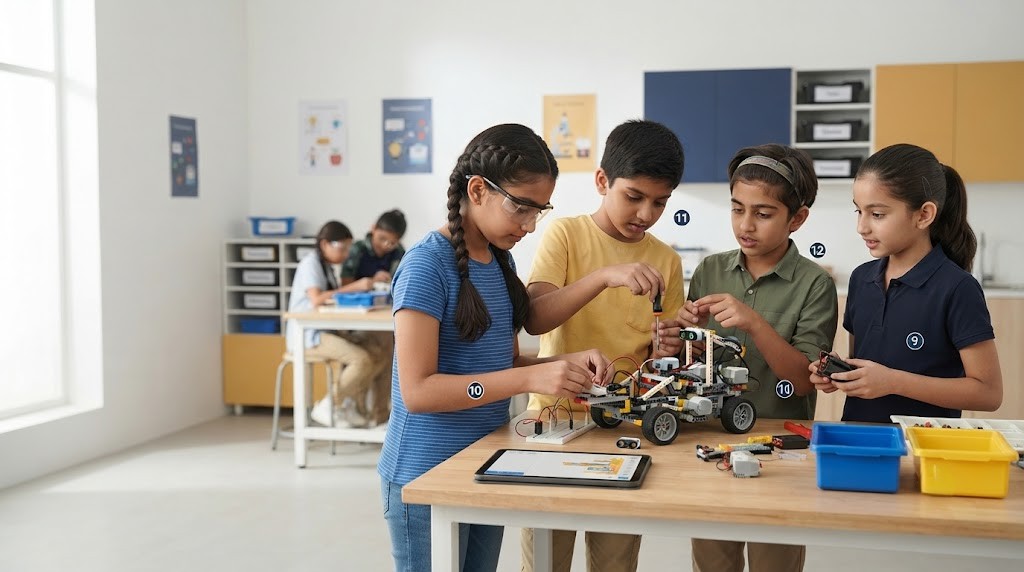
Robotics projects combine mechanical design, electronics and programming. A student building an obstacle-avoiding or line-following robot has to think about sensor placement, motor control, power management and code logic simultaneously — a genuinely multidisciplinary challenge that mirrors real engineering work.
Coding Projects
From simple games built in block-based platforms to Python scripts that process data, coding projects teach students to plan logic, write instructions precisely, and debug when the output does not match expectations — a core professional skill in software development and far beyond it.
Arduino Projects
Arduino-based projects, such as automated lighting systems, temperature-based fans, or sound-triggered alarms, teach students how code can control the physical world in response to sensor input, bridging the gap between software and hardware in a very tangible way.
AI Projects
Beginner AI projects, such as training a model to recognise images or classify simple data, introduce students to how machine learning systems are trained and evaluated, while also building an understanding of why data quality matters and where AI can go wrong.
IoT Projects
IoT projects, like a sensor-based system that reports data to a mobile dashboard, teach students how physical devices communicate over the internet — an increasingly important skill as connected devices become part of everyday life.
Combining Multiple Skills Into One Capstone Project
As students progress, the most valuable projects often combine several skills at once — for example, an IoT-connected robot that uses a trained image-recognition model to identify an object and then physically respond to it. These capstone-style projects mirror real engineering work closely, requiring students to plan how different systems will communicate with each other, manage limited time and resources, and debug issues that could originate from hardware, software, or the connection between the two.
What Real Learning Looks Like During a Project
It is worth clarifying what "learning" actually looks like inside a project-based STEM session, because it often does not resemble a traditional classroom at all. A student might spend fifteen minutes simply figuring out why a sensor is not reading correctly, testing different wiring configurations one at a time. From the outside, this can look like slow progress. In reality, this is exactly where the deepest learning happens — the student is actively forming and testing hypotheses, which is a far more valuable exercise than watching a demonstration of the same concept.
The Role of Mentors in Project-Based Learning
Good mentoring in a project-based environment does not mean solving the problem for the student. Experienced mentors ask guiding questions — "what does the sensor reading show right now, and what would you expect if the wiring were correct?" — that help students reach the answer themselves. This approach takes more patience than simply providing a fix, but it is what allows students to genuinely internalise the troubleshooting process rather than relying on someone else to solve every issue for them.
Learning From Failure
In a project-based environment, failure is not the end of the process — it is expected as part of it. A circuit that does not light up, or code that throws an error, is simply information that guides the next attempt. Students who build real projects repeatedly experience this cycle, and over time, they develop genuine resilience: the ability to stay calm, diagnose an issue methodically, and try again without becoming discouraged. This is a markedly different relationship with failure than the one built by exams, where a single wrong answer often feels final.
Why Parents Should Value the Process, Not Just the Finished Project
It is natural for parents to focus on the final result — did the robot work, did the app run correctly. But the real value of project-based STEM learning lies in the process that led there: the false starts, the debugging, the small adjustments made along the way. A finished project that came together on the first try often reflects less learning than one that took several failed attempts to get right. When talking with children about their projects, asking about what did not work at first, and how they fixed it, reinforces the idea that the process itself is the achievement, not just the outcome.
Problem-Solving, Creativity and Communication
Real projects rarely have a single correct path to completion, which means students have to make design decisions, weigh trade-offs, and sometimes invent their own solution to an unexpected problem. This builds problem-solving and creativity together, since students are constantly asking, "what else could work here?" When projects are done in teams, students also have to explain their reasoning, divide responsibilities and combine different ideas into one functioning outcome — developing communication and collaboration skills that are difficult to teach through individual, theory-based work.
Teamwork and Confidence
Completing a real, working project — one that a student can demonstrate, explain and be proud of — has a noticeable effect on confidence. Unlike a test score, a working robot or a functioning app is tangible proof of capability. Students who build projects in a team setting also learn to trust their peers' expertise, hand off responsibility for parts of a project they are less confident in, and step up where they have more skill — all while building the kind of collaborative confidence that matters well beyond the classroom.
How Project-Based Learning Differs Across Age Groups
The scale and complexity of projects naturally change as students grow:
- Younger students (6–8): Short, guided builds such as simple circuits or basic structural challenges, designed to introduce the idea that ideas can be tested and improved.
- Middle learners (9–11): Slightly longer projects involving block-based coding and beginner microcontroller builds, where students start making more independent decisions about design.
- Teen builders (12–18): Multi-step, often multi-session projects involving robotics, Python, AI or IoT, where students plan, build, test and refine a project largely on their own, with mentor guidance rather than step-by-step instruction.
This gradual increase in complexity and independence mirrors how real technical skills are built over time, and it ensures that project-based learning stays appropriately challenging rather than overwhelming at any given stage.
Building a Student Portfolio
One of the most underrated benefits of project-based STEM learning is that it naturally produces a portfolio. Instead of a stack of graded worksheets, a student accumulates a collection of real, working projects — a circuit, a robot, a coded game, an IoT dashboard — that demonstrate a growing range of skills over time. This portfolio becomes genuinely useful later, whether for school science exhibitions, competitions, college applications, or simply as a source of confidence and motivation for the student to keep building.
School Science Projects and Competitions
Students who are used to project-based STEM learning are typically far better prepared for school science exhibitions, robotics competitions and innovation challenges, because they are already comfortable with the full cycle of designing, building, testing and presenting a project. Structured mentoring support for these projects — helping students refine their idea, troubleshoot technical issues, and prepare a clear explanation of their work — can make a significant difference in how confidently a student performs at these events.
How Project-Based STEM Learning Prepares Children for Future Technology Careers
Nearly every technology career, from software engineering to robotics, data science and product design, is fundamentally project-based: teams are given a goal, they design a solution, build it, test it, and refine it based on results. Children who grow up learning this way are not just gaining early technical skills — they are gaining direct, repeated practice with the exact process that professionals use every day. This is a significant advantage compared to learning that stops at theory, because it builds not just knowledge, but the practical instincts and confidence needed to apply that knowledge in the real world.
Getting Started With Project-Based STEM Learning
Parents interested in project-based STEM learning do not need to make a large commitment immediately. A single trial session is usually enough to see whether a program is genuinely hands-on — watch for whether the child spends most of the time building and testing something themselves, or mostly watching a mentor demonstrate. Asking to see examples of past student projects, and whether the program follows a structured, age-wise pathway, are two of the most useful questions a parent can ask before enrolling.
Conclusion
Project-based STEM learning works because it mirrors how real problems actually get solved — through building, testing, failing, adjusting and trying again. Whether it is a simple circuit, a robot, a coded game or an IoT dashboard, every completed project leaves a child with more than just a working device. It leaves them with problem-solving skills, creativity, confidence, teamwork experience and a growing portfolio of real evidence of what they can do — exactly the kind of foundation that prepares children for future technology careers and for confidently tackling whatever comes next.
Frequently Asked Questions
Project-based STEM learning is an educational approach where students learn science, technology, engineering and math concepts by designing, building and testing real, working projects, rather than only studying theory and being tested on it separately.
Project-based learning connects concepts to real, visible outcomes, so students understand not just what should happen but why it actually happens when something does not work as expected. This produces deeper, longer-lasting understanding than theory alone.
Students can build a wide range of projects depending on their level, including simple circuits, obstacle-avoiding robots, block-based or Python coding projects, Arduino-based automation systems, beginner AI models, and IoT projects connected to mobile dashboards.
In project-based learning, a failed attempt is treated as useful information rather than a final result. Students repeatedly experience troubleshooting and retrying, which builds resilience and a calmer, more methodical approach to problems over time.
Yes. Students who regularly build real projects are typically much better prepared for school science exhibitions and robotics or innovation competitions, since they are already comfortable with designing, building, testing and presenting their work.
Instead of graded worksheets, project-based learning naturally produces a growing collection of real, working projects, such as circuits, robots, coded games and IoT systems, which can be showcased in exhibitions, competitions or as evidence of a student\'s growing skills.
Yes, as long as projects are structured around an age-wise pathway that starts with simple builds and gradually introduces more advanced concepts. Beginners typically start with simple circuits and visual coding before progressing to robotics, Python and AI projects.
Most technology careers are inherently project-based, involving designing, building, testing and refining a solution as a team. Students who practise this cycle repeatedly through STEM projects gain direct experience with the exact process used in real technology careers.
Team-based projects add valuable communication and collaboration practice, but individual projects are also effective for building problem-solving and technical skills. Many structured programs use a mix of both formats depending on the project and age group.
Want your child building projects like this?
Book a free trial class and see the STEMAIR learning style in action.
